
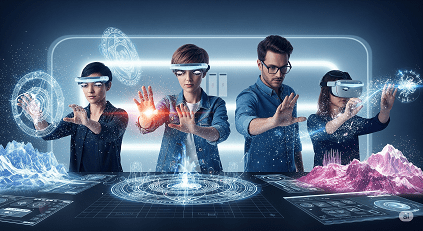
Imagine being transported to a digital world, where you can see virtual objects that aren’t physically there, or where you’re completely immersed in an imaginary realm. This is Augmented Reality (AR) and Virtual Reality (VR). These aren’t just concepts from movies anymore; they are rapidly evolving technologies. Major companies are now heavily investing in AR VR technology for their businesses. Together, they are also known as Extended Reality (XR). This modern technology is actively shaping and showing us what our future will be like.
This immersive technology is currently gaining momentum at an incredible pace. By approximately 2030, the market for AR and VR is expected to reach its peak, and likely go even further. The main drivers for this growth are new and improved devices (hardware), more sophisticated software development, and a growing understanding that AR/VR solutions can effectively solve complex future visualization and interaction problems across many industries. Therefore, for those aspiring to pursue a career in this modern technology, there are abundant and exciting AR VR career opportunities.

Why Choose a Career in AR and VR?
Choosing a career in AR and VR means propelling your professional journey forward, with a strong focus on tomorrow’s innovations. Here are some compelling reasons why this field is attracting top professionals:
- High Demand, Talent Shortage: The rapid expansion of the immersive tech industry has created a huge demand for specialized skills, especially in XR software engineering. This means that if you possess these valuable skills, the AR VR job market is significantly less competitive for you.
- Competitive Salary: Due to the current high demand for AR VR talent, salaries for AR VR developers and other specialists are highly competitive globally, offering excellent opportunities for substantial earnings.
- Diverse Applications: It’s not just about gaming anymore! AR/VR technology is revolutionizing healthcare, manufacturing, education, retail, real estate, and many other sectors. Large companies are increasingly adopting AR VR solutions to solve complex problems and create groundbreaking experiences.
Top Career Paths in AR and VR: What Education You Should Pursue
So, here are some key AR VR job roles and insights into the education you might need to pursue a career in AR and VR:
- AR/VR Developer/Engineer: This is often the most sought-after AR VR role. You’ll be responsible for building the actual AR/VR applications and experiences. Key skills include proficiency in programming languages like C# (for Unity) and C++ (for Unreal Engine), along with expertise in development platforms like ARKit, ARCore, and WebXR.
- 3D Artist/Modeler: Immersive experiences demand stunning visuals. 3D artists create the characters, environments, and objects that populate AR/VR worlds using tools like Blender, Maya, and 3ds Max.
- Technical Artist: Bridging the gap between pure art and engineering, technical artists optimize 3D assets for performance within AR/VR environments and assist developers with graphic implementations.
- Graphics Programmer: These specialists delve deep into rendering pipelines, working with shaders (HLSL, GLSL, Metal) to create highly realistic visual effects and optimize graphics performance for XR experiences.
- UX/UI Designer (for AR/VR/XR): Designing intuitive and natural user experiences in 3D space is critical for immersive applications. These designers focus on spatial computing, interaction design, and usability to ensure seamless engagement.
- Immersive Storyteller/Content Creator: Crafting compelling narratives and interactive content is vital for engaging AR/VR experiences, whether for entertainment, education, or marketing.
- AR/VR Project Manager: These professionals oversee the entire lifecycle of AR/VR projects, from conception to deployment, ensuring successful execution and collaboration across multidisciplinary teams.
- AR/VR Research Scientist: For those with a strong academic background, research scientists explore cutting-edge algorithms, new hardware possibilities, and novel applications of AR/VR technology.
- QA Tester (for AR/VR): Ensuring the functionality, performance, and usability of AR/VR applications is paramount, making QA testers crucial to the development process and overall quality of XR products.
Essential Skills to Thrive in AR & VR Careers
To secure a rewarding career in AR & VR, a strong combination of technical prowess and critical soft skills is indispensable.
- Programming Languages: C#, C++, Python, Java, Swift (especially for mobile AR development).
- Game Engines/Development Platforms: Unity (highly popular for both AR and VR development), Unreal Engine (known for high-fidelity VR experiences), ARKit, ARCore, WebXR.
- 3D Modeling & Animation Software: Blender, Maya, 3ds Max, Cinema4D.
- Understanding of XR Concepts: A solid grasp of AR, VR, and Mixed Reality (MR) principles is fundamental for any immersive technology professional.
- Computer Vision & AI/ML Fundamentals: Essential for object recognition, tracking, and building intelligent, responsive AR/VR experiences.
- Spatial Audio: Designing realistic and immersive soundscapes significantly enhances the user experience in AR/VR applications.
- Graphics Programming: Knowledge of shaders and rendering techniques for optimizing visuals in XR environments.
How to Build a Career in AR and VR?
Education and practice play a key role in any career path. So, what should you study and how can you gain practical experience to build a successful AR VR career?
- Formal Degree: A degree in computer science, software engineering, game design, or UX design strengthens your foundational knowledge for XR development.
- Specialized Courses: Many online platforms like Coursera, Udemy, Udacity offer focused AR/VR development training. Additionally, some educational institutes are now offering traditional offline education in immersive technologies.
- Self-learning and Practice:
- Online Tutorials: Take advantage of free resources like YouTube and official documentation from Unity/Unreal Engine to learn practical skills.
- Create a Portfolio: This is the most important step for any AR VR professional! Develop personal projects to showcase your skills – from simple AR filters to complex interactive VR experiences. Your AR VR portfolio is your resume in this field.
- Participate in Hackathons and Game Jams: These are great opportunities to gain hands-on experience, collaborate with peers, and rapidly prototype ideas in an XR development context.
Conclusion: Your Immersive AR VR Future Awaits!
The world of augmented reality and virtual reality is no longer just a niche; it’s a rapidly expanding field. With diverse AR VR career paths, competitive AR VR salaries, and exciting integrations with AI, now is truly the best time to consider building your future in this immersive domain.
Ready to explore the possibilities of AR VR jobs? Start learning, build your AR VR portfolio, and be part of the next digital revolution!
